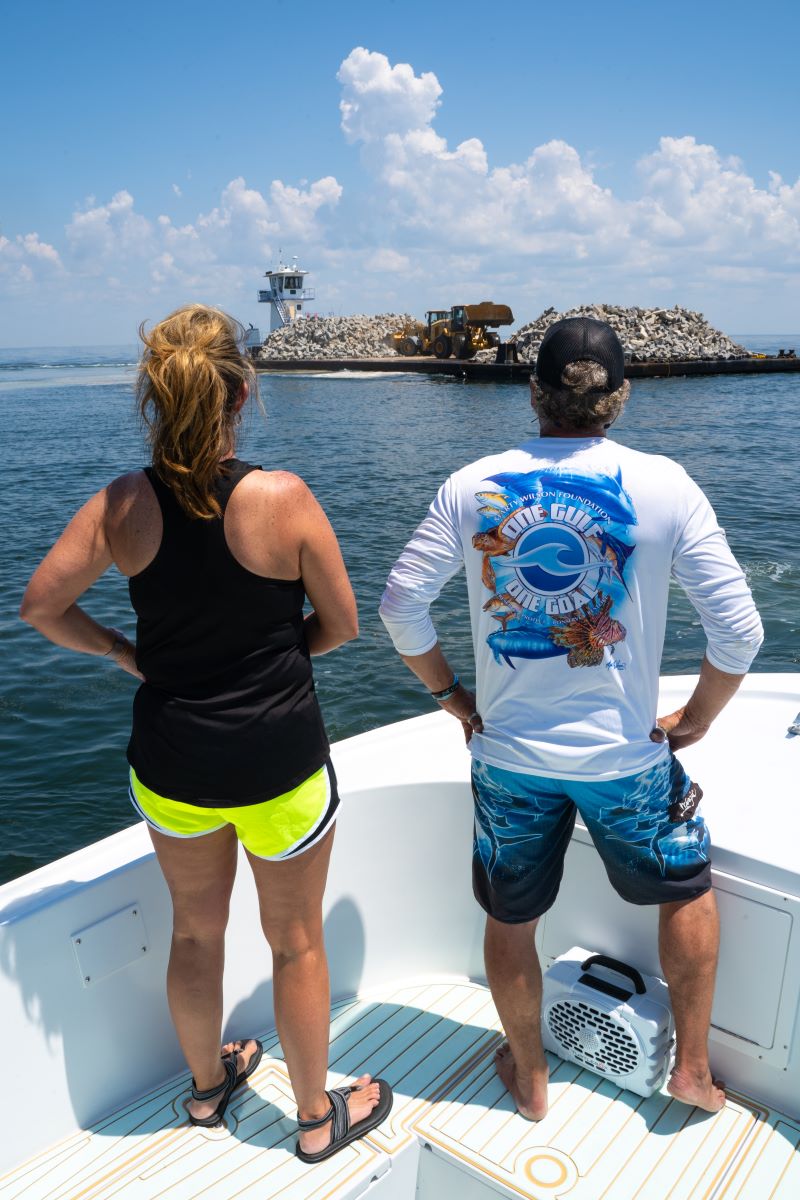


Such Fish Havens have been monumental to restoring fisheries that have seen a significant decrease in population due to overfishing and the removal of oil rigs that were previously used by fish for shelter, such as Red Snapper. According to Magnusen and Wilson the impact is significant and noticeable even after just a six month period, with a steady and abundant rise of new fish readying the fisheries for fishermen.
“We were awarded 1.8 million to put artificial reefs back in our fish havens.” Says Magnusen. “Governor Tate Reaves approved it and that’s currently what we’re working on now.”
“That project is to put 300 artificial reefs in the water that are probably 10 feet by 10 feet footprints.” Continues Marty, jumping off of Magnusen’s statement. “We’re actually working on some more organic 3D designs that look like they fit more into the marine environment. Our mix designs will have a lower pH footprint withadditives like bagasse, which is a byproduct of sugarcane, are totally organic. Instead of fiberglass hairs, we’re using more of like a wood fiber and then also the bio-char additive which is the burnt bagasse that has a microscopic carbon ladder that adds to the tensile strength. One of the byproducts of that is that it reduces the carbon footprint there to make it more pH neutral so that it’s accepted into the marine environment quicker.”
A lower pH footprint also allows for more biodiversity, and for growth at an accelerated rate for the fishery. This includes not just room for juvenile fish such as baby Red Snapper and Grouper, but algaes, oysters, barnacles, small bait fish and tube boring worms. But, while important, this project is just one of many that One Gulf One Goal is involved in. Another important concern is the declineing Cobia fishery.
“The Cobia tagging program was instilled a long time ago by one of our hero marine biologists Jim Franks.” Says Wilson. He’s been at the research lab forever and we’ve gained a lot of valuable information about that species, and unfortunately that fishery has been overfished. It’s in trouble, and we’ve been looking for an answer- one of our ideas was the Cobia lisence plate. When you buy one you’re actually buying one fingerling baby Cobia enough food to raise it to about 6 to 8 inches and released back into the wild. Then, when you renew your tag the funding will be there year after year throughout our states courthouses- but we’re still trying to get that off the ground. In the meantime we’ve got another project in the works to do a Cobia release of 10,000 baby Cobias per year, and do a five year program. If we can find some good science behind this over the course of three years, we could get a two year extension.”